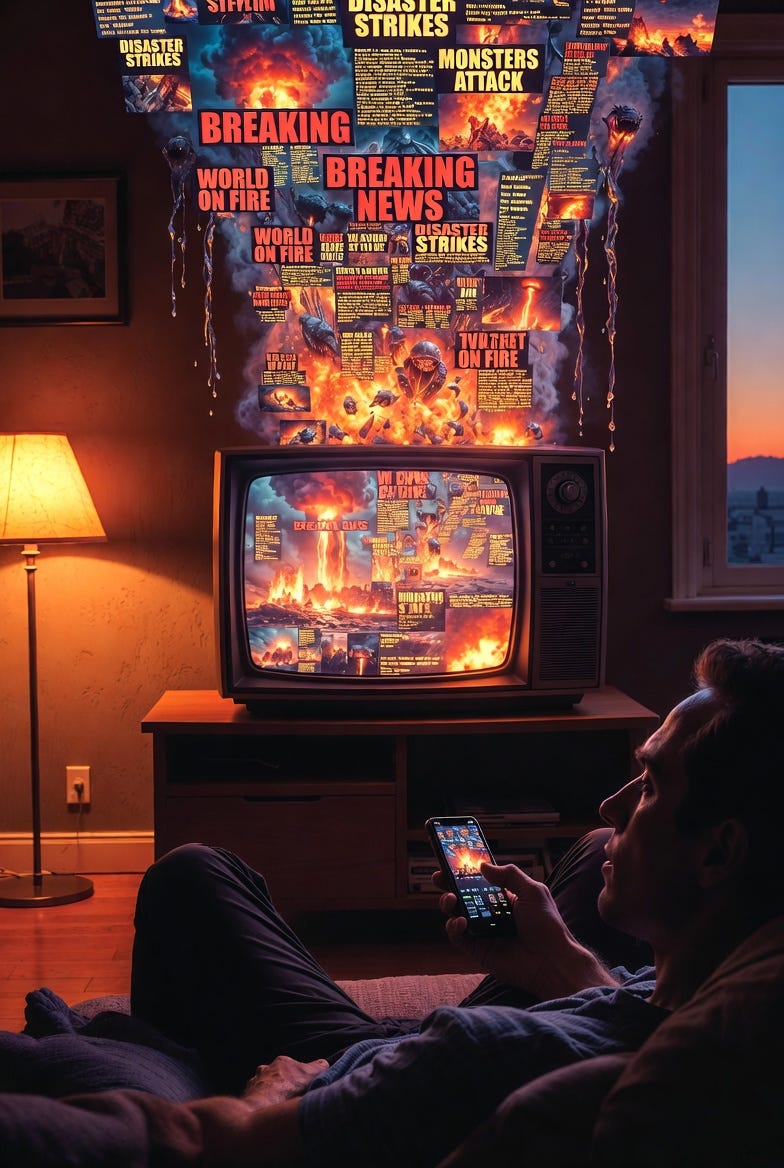
Attention markets reward emotional force, not calibration. As possibility gets packaged as inevitability and every risk is framed like imminent collapse, people lose the ability to distinguish signal from spectacle. The cost is not just anxiety. It is a society that becomes more cynical, more reactive, and less capable of coordinated judgment.
This website version is the primary readable edition of the piece. If a related public post exists elsewhere, it is linked near the end for reference.
Fear Works Because It Wins the Attention Auction
A great deal of modern media does not merely compete on truthfulness or usefulness. It competes on force. In that environment, calm framing loses. Caveats lose. Uncertainty loses. Threat wins.
This does not always require fabrication. Often the facts are real but thin, while the emotional packaging is enormous. Risk becomes atmosphere. Possibility becomes mood. By the time the story reaches the feed, it no longer feels like information. It feels like danger entering the room.
That is why fear is such a durable business model. It is sticky, memorable, and easy to monetize.
Speculation Keeps Getting Sold as Reality
One of the most corrosive moves in the attention economy is the shift from possibility to inevitability. Language that should remain conditional gets tightened, sharpened, and dramatized until it reads like forecast instead of caution.
Could lead to becomes will lead to. Raises concerns becomes crisis looming. That shift sounds small, but it radically changes how people inhabit the information. Uncertainty is no longer something to think about. It becomes something to absorb.
Corrections almost never travel as far as the initial spike. The alarm shapes public mood; the clarification arrives later, weaker, and often to fewer people.
The Cultural Bill Shows Up Slowly
There is no obvious moment when a public crosses from informed to emotionally exhausted. The damage accrues gradually. People become more numb, more suspicious, more cynical, and less willing to believe anything can improve.
That matters because trust is not limited to institutions. It includes trust in neighbors, in shared reality, and in the basic worth of planning for the future. A media environment that continuously monetizes dread degrades all three.
The deepest damage is therefore not that people feel scared in the moment. It is that they begin to organize their relationship to public life around anticipatory defeat.
Human Beings Were Not Built for Permanent Emergency
A nervous system can handle acute stress. It cannot thrive inside constant implied catastrophe. When people are bathed in urgency all day, they tend to move toward one of two states: obsessive monitoring or total disengagement.
Neither is healthy. One turns people into anxious risk accountants. The other turns them into exhausted spectators who stop participating because everything feels theatrical and rotten anyway.
Permanent emergency makes judgment worse. It narrows the range of responses until panic and apathy start to look like the only two settings available.
Refusing Panic Is Not the Same as Refusing Reality
The right response is not ignorance. It is hygiene. Check information intentionally instead of grazing all day. Prefer sources that distinguish what happened from what might happen. Treat sensational framing as a form of packaging, not as neutral description.
Real threats exist and some warnings are justified. But a system that keeps people emotionally inside danger whether or not the facts warrant it is not simply informing the public. It is managing attention through cortisol.
If a culture is fed enough panic for long enough, the bill arrives in trust, judgment, and civic capacity. That is a very expensive price to pay for a stronger headline.
FROM NOTE TO EXECUTION
If this issue is active in your organization, we can pressure-test it together.
The article is there to sharpen the model. The engagement is there to change the operating reality.